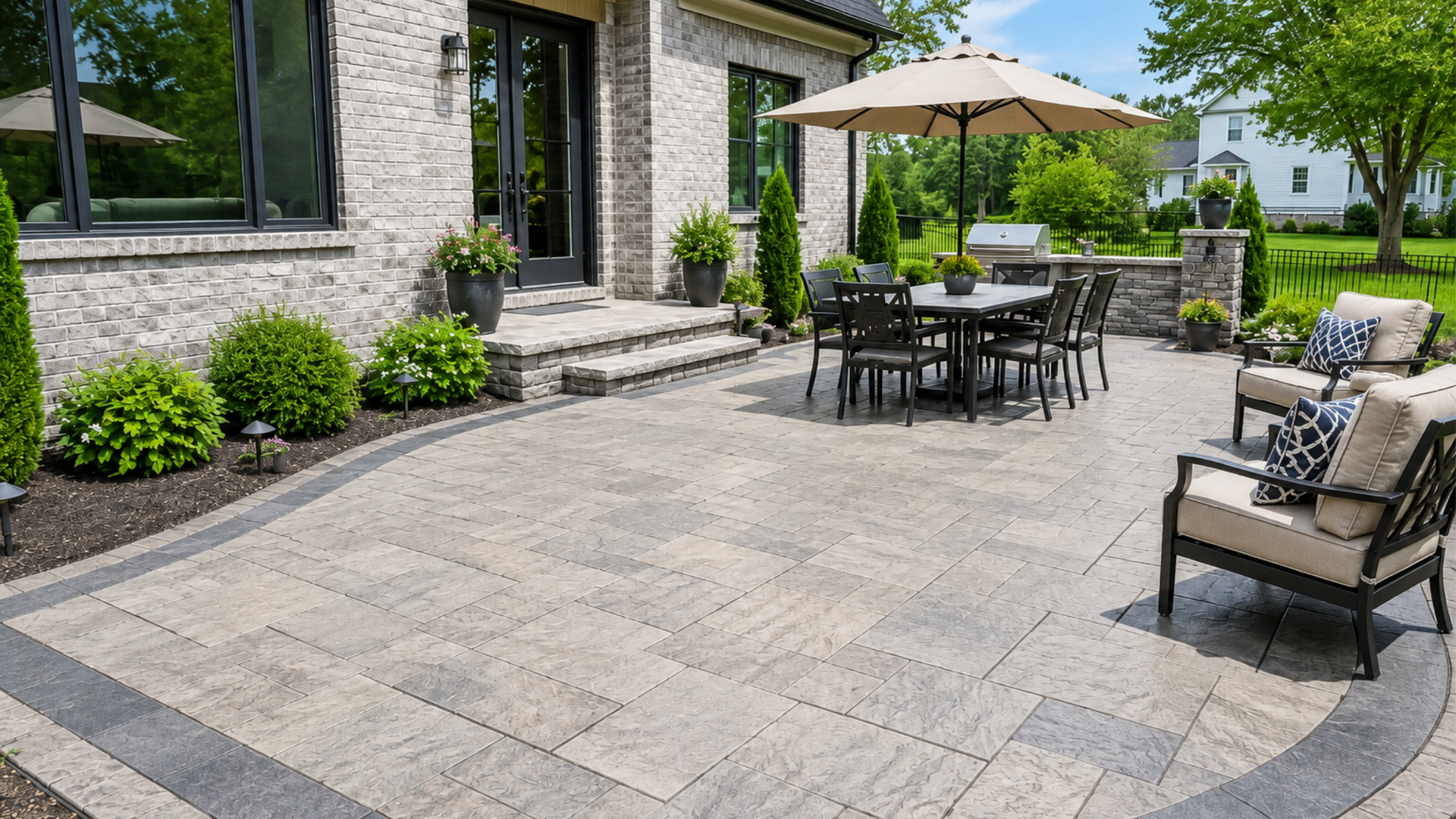
The Best Time to Pour Decorative Concrete in Northwest Ohio
Most homeowners settle on a stamp pattern and a color long before they think about a calendar. That order is backwards. In Northwest Ohio, the month you pour can matter as much to how a decorative slab looks in year ten as the design choices you make in the showroom.
The short answer: the best time to pour decorative concrete in Ohio runs from late April through mid October, and the strongest stretch is late August into early October. Air temperatures are mild, humidity is easier to work with, and the slab has enough season left to gain strength before the first hard freeze.
The longer answer explains why. Weather does not just decide whether a crew can work. It changes how color develops, how long a stamp stays workable, when a sealer can go down, and how well the surface survives its first Lake Erie winter. Across more than eleven years and 300-plus projects here, the pours that hold up best tend to be the ones scheduled around those realities rather than around a target date. What follows is each season handled honestly, tradeoffs included.
Why Timing Matters More for Decorative Concrete
Plain gray flatwork is easier to get right. You place it, screed it, float it, broom it, and the finish is done. Decorative work is different: the finishing window is longer, more hands touch the surface, and the surface itself is the product.
A stamped patio has to be placed, leveled, floated, colored, and then stamped while the concrete sits in a narrow window. Too wet and the stamp mats sink and blur. Too stiff and the pattern will not press in at full depth. That window might be three hours on a mild September morning. On a 92 degree July afternoon with wind, it can shrink to under an hour.
Temperature drives this directly. Cement hydration roughly doubles in rate for every 18 degree rise, so a mix with 90 minutes of working life at 70 degrees may give a crew about 45 minutes at 95 degrees. Every step after that gets compressed.
That is the practical reason timing matters. The durability reason matters more.
The Freeze-Thaw Problem Behind Most Surface Damage
Northwest Ohio has a demanding freeze-thaw climate. The region cycles above and below freezing repeatedly through winter rather than staying frozen, and each cycle pulls water into the surface and freezes it there. That is what causes the flaking and pitting you see on older patios and driveways around the area.
Concrete fights this with air entrainment, meaning microscopic air bubbles mixed in on purpose to give freezing water somewhere to go. Around 6 percent air and 4,000 psi concrete is the general target for exterior flatwork in a climate like ours.
Decorative work adds a wrinkle. Those same air bubbles reduce the surface moisture that color needs to develop evenly, so the mix has to balance appearance against durability. You do not need to know the numbers. You do need a contractor who specs for this climate instead of copying one from a warmer market, and it is a fair thing to ask about when you compare bids.
The Northwest Ohio Pouring Season at a Glance
Toledo area frost data gives a workable frame. Fall frost risk begins around mid October and is near certain by early November, while spring frost risk drops off through late April into mid May.
| Period | Pour Suitability | What Drives It |
|---|---|---|
| Dec - Feb | Restricted | Sustained cold, frozen subgrade, protection required, no sealing |
| March | Limited | Thaw, saturated soil, unstable subgrade |
| Mid Apr - May | Good | Frost risk falling, moderate temps, heaviest booking demand of the year |
| June | Good | Stable, warm, long working days |
| July - mid Aug | Workable | Heat compresses finishing window, early starts and evaporation control |
| Late Aug - Sept | Excellent | Moderate temps, wide stamping window, strength gained well before freeze |
| Early Oct | Good | Still viable, sealing window narrowing |
| Late Oct - Nov | Conditional | Cold weather protocols, sealing likely deferred to the following spring |
Spring: The Most Requested Window and Its Hidden Catch
Spring is when the phone rings. Homeowners come out of winter looking at a cracked patio, picture themselves entertaining by Memorial Day, and want it done.
Spring does work. Temperatures through late April and May usually land in a comfortable range for placing and finishing, and a slab poured in May has the whole warm season to gain strength.
The catch is underneath. Northwest Ohio soils hold water, and the heavy clay drains slowly. A subgrade that is saturated in early April is hard to compact properly, and a slab built on a soft base can settle unevenly even when the finish work is excellent. Our crews would rather wait a week for the ground to dry than force a pour on a base we are not confident in, and we will say so at the on-site evaluation.
The second catch is scheduling. Spring is the busiest window of the year for concrete contractors across the region. Calling in April for a May pour often means competing for slots that were reserved back in January.
If you want spring, start the conversation in winter.
Summer: The Longest Window With a Finishing Clock
June through mid August offers the most usable working days, and the most finishing risk for decorative work.
The thermometer alone does not tell you much. What matters is the combined effect of air temperature, concrete temperature, relative humidity, and wind on how fast water leaves the surface. Industry guidance for hot weather concreting treats an evaporation rate approaching 0.2 pounds per square foot per hour as the threshold where precautions against plastic shrinkage cracking become necessary. A hot, dry, breezy afternoon can cross that line quickly.
Plastic shrinkage cracking happens when the surface dries faster than bleed water can rise from below. The top layer shrinks while the concrete underneath is still soft, and fine cracks open before anyone has finished troweling. On a stamped surface these show up as hairlines running through the pattern.
Pro Tips for Northwest Ohio Summer Pours
- Start early. A 6:00 or 7:00 AM placement on a July job puts the finishing work into the coolest hours, before afternoon heat and wind arrive.
- Watch the wind, not just the heat. A 78 degree day with 20 mph wind and low humidity can be harder on a fresh surface than a still 88 degree one.
- Ask about evaporation retarders. These are thin films sprayed on between finishing passes that slow moisture loss without adding water to the mix. Adding water to keep concrete workable weakens it and is a common cause of scaling later. It is the shortcut we watch for most closely on summer jobs.
- Expect a rain plan. A summer thunderstorm on a freshly finished decorative surface can wash out color and pit the finish. Any crew working in July should have covering on the truck, not back at the shop.
Late Summer Into Early Fall: The Strongest Window
If you have flexibility, this is the stretch we point most homeowners toward. Late August through early October tends to give Northwest Ohio the best combination of conditions for decorative work.
Air temperatures settle into a comfortable range. Overnight lows stay well above freezing. The stamping window opens back up, which gives a crew time to work color and detail properly instead of racing the set. Humidity is usually easier than midsummer, and the afternoon storm risk drops. On a mild September morning our crews can take the time a hand-detailed border actually needs.
A slab poured in early September also has six to eight weeks of decent weather before the first hard freeze. Concrete needs to reach roughly 500 psi before freezing can occur without damage, and it keeps gaining strength well past that. Early fall pours clear that bar with room to spare.
The one limit is the sealer. Most decorative sealers need the slab to cure roughly 28 days first, applied at surface temperatures between 50 and 90 degrees, dry during application and for at least 24 hours after. A patio poured September 5 hits its 28 day mark in early October, which usually still works. A patio poured October 10 will likely wait until spring.
Late Fall and Winter: When Pouring Still Makes Sense
Contractors here do pour into November and sometimes beyond, and we have when a project called for it. It is not automatically a bad decision, but it should be made on purpose rather than by default.
The American Concrete Institute's ACI 306R defines cold weather concreting as the period when air temperature has fallen to, or is expected to fall below, 40 degrees during the protection period. Below 50 degrees hydration slows sharply. Below 40 it nearly stops. If concrete freezes before reaching roughly 500 psi, the water inside expands and permanently damages the paste.
What Cold Weather Protection Actually Involves
Protecting a late season pour is real work, and it should show up in your proposal, not as a surprise.
- Heated mix water or aggregates so the concrete arrives warm enough to place.
- Insulating blankets over the slab to hold heat through the protection period.
- Ground thawing if the subgrade is frozen. Concrete should never be placed on frozen ground, because that soil thaws and settles later, and the slab settles with it.
- A longer schedule. Everything takes longer in the cold, including the wait before forms come off.
- Deferred sealing. A November slab will not be sealed until spring, so it faces its first winter unsealed.
When does a late pour make sense? When a project is already underway and stopping would create a bigger problem, or when a homeowner wants the base work done so finish work can start right away in spring. When the only reason is impatience, we will usually recommend waiting until April, and we would rather say so during the proposal than after the pour.
How Weather Shapes Color and Finish
This is where decorative concrete differs most from ordinary flatwork, and it is worth its own section.
Color hardener depends on bleed water. It is worked into the surface and needs surface moisture to activate evenly. Too much bleed water in cool damp conditions dilutes it. Too little in hot dry conditions leaves it patchy. Both cause blotching that cannot be fixed later without resurfacing.
Antiquing release behaves differently by temperature. The powders used to create depth and shadow in a stamped pattern sit differently on a hot slab than a cool one, and the wash-off step afterward is temperature dependent too.
Curing conditions affect the final shade. The same mix and color can finish lighter or darker depending on how fast it cured and how evenly it held moisture. Two patios from the same color card, one poured in May and one in August, are unlikely to match exactly. It is why we pour a patio and its adjoining walkway in the same placement wherever the site allows.
Efflorescence shows up more in cool damp weather. This is the white mineral haze that works its way to the surface, more common on slabs poured in humid conditions that dry slowly. It can usually be cleaned up, but it is an unwelcome surprise on a new patio, so we raise it at walkthrough on late-season jobs.
Curing and Sealing: The Timeline That Decides Your Finish
Homeowners often ask how long decorative concrete takes to dry. Drying and curing are different things, and the second one matters more.
| Milestone | What It Means |
|---|---|
| 24 - 48 hours | Surface firm enough for careful foot traffic. Keep pets and furniture off. Do not remove curing protection. |
| 7 days | A large share of design strength developed under normal conditions. Light use acceptable on most patios. |
| 28 days | Standard reference point for design strength and the typical minimum before applying most sealers. |
| First winter | Avoid deicing chemicals entirely. Industry guidance recommends no deicers during the first winter. |
| Every 2 - 4 yrs | Resealing interval for most decorative surfaces, depending on exposure, traffic, and sealer type. |
That first winter guidance is worth repeating, because reaching for the salt bag is one of the most common ways a new decorative surface gets damaged. Rock salt and calcium chloride on a young slab speed up scaling, and it shows the following spring as flaking and pitting through the pattern. Sand gives traction without the chemistry. It is the last thing we cover at final walkthrough on every fall pour, and when resealing time comes, concrete restoration and resealing costs far less than replacement.
Planning Backward From Your Ideal Completion Date
The more useful question is not when concrete can be poured, but when to make the call.
| Target Pour | Start Conversations | Why |
|---|---|---|
| Late Apr - May | January - February | Peak demand window, books out first every year |
| June - July | March - April | Design and permits resolved before season load peaks |
| Late Aug - Sept | May - June | Best finish window, worth reserving early |
| October | July - August | Sealing timeline needs to be confirmed at proposal stage |
Between the first conversation and the pour, a project usually needs an on-site evaluation, design and finish selection, a written proposal, permitting where it applies, and scheduling with the ready-mix supplier. At Nexus Concrete Group that sequence runs through one project manager rather than several hand-offs, which is much of why it holds together. Rushing it is where projects go wrong.
Site Conditions That Matter as Much as the Calendar
A good September day cannot rescue a bad site. A few conditions matter regardless of season.
Drainage and slope. Water needs somewhere to go. Standing water on a decorative surface through freeze-thaw cycling is a fast route to surface damage. This matters most around pool decks and pool coping, where drainage and slip resistance both come into play.
Subgrade quality. The base under the slab does the structural work. Northwest Ohio clay soils need proper preparation and compaction, and shortcuts here tend to show up as settlement cracks within a few years. It is the least visible part of the job and the part we spend the most time on.
Frost depth for anything with footings. A patio slab sits on grade, but a pergola, pavilion, or outdoor kitchen has footings that must extend below the local frost line. Ohio does not set one statewide number, and northern jurisdictions commonly require more depth than central and southern parts of the state. Perrysburg sits in Wood County, while Sylvania, Ottawa Hills, and Whitehouse fall under Lucas County, so we confirm the requirement with the local building department on each project rather than assuming one number covers the whole service area. This matters for premium flatwork and outdoor structure slabs supporting any permanent structure.
Matching Timing to Your Project Type
Different projects carry different scheduling pressures.
A stamped patio has the tightest finishing window of any residential decorative pour, because the pattern has to go in while the concrete is soft enough to take it and firm enough to hold it. Stamped and decorative concrete patios benefit most from the mild conditions of late spring and early fall.
A decorative driveway means more square footage and a longer continuous placement, which raises the value of a cool start and a full crew. Vehicles also need to stay off longer than foot traffic does. Decorative concrete driveways scheduled in early fall avoid both midsummer heat and traffic arriving too soon.
Retaining walls and hardscape features care less about the finishing window and more about soil moisture, since digging in saturated clay is slow and drainage details need dry conditions. Late summer often suits hardscaping and retaining walls.
Frequently Asked Questions
What is the best month to pour decorative concrete in Northwest Ohio?
September is the strongest single month for most decorative projects. Temperatures settle into a comfortable working range, the stamping window widens, humidity is easier to manage than midsummer, and the slab still has several weeks of mild weather to gain strength before the first hard freeze. Late August and early October are close behind.
How long does decorative concrete take to dry?
Surfaces are usually firm enough for careful foot traffic within 24 to 48 hours, but that is not the same as cured. Concrete develops much of its design strength within about seven days under normal conditions, and 28 days is the standard reference point. Most sealers require that 28 day wait. Cool weather stretches all of these timelines.
Can concrete be poured in winter in Ohio?
Yes, with proper cold weather practices. ACI 306R defines cold weather concreting as beginning when air temperature has fallen to or is expected to fall below 40 degrees during the protection period, and it calls for heated mix water, insulating blankets, and thawed subgrade. Concrete should never be placed on frozen ground. Winter pours cost more, take longer, and cannot be sealed until spring, so they are worth doing only when there is a real reason not to wait.
Is spring or fall better for a stamped patio?
Fall, in most cases. Spring works well on weather alone but carries two disadvantages: saturated subgrade from thaw and rainfall, and the heaviest booking demand of the year. Early fall offers similar conditions with drier soil, more schedule availability, and enough season left to seal before winter.
When can I seal a new decorative concrete patio?
Most sealers require roughly 28 days of curing first, applied when surface temperatures are between about 50 and 90 degrees on a dry surface, with dry conditions holding for at least 24 hours afterward. For late season pours this often means deferring sealing until the following spring. That is normal and is not a defect, though it should be discussed at proposal stage so expectations are clear.
Does pouring in cold weather make concrete weaker?
It can, if the pour is not protected. Hydration slows sharply below 50 degrees and nearly stops below 40. If the concrete freezes before reaching roughly 500 psi, the damage is permanent. Protected cold weather pours can reach full design strength, but that protection has to be planned and monitored, not assumed.
Should I use salt on my new decorative concrete this winter?
No. Industry guidance recommends avoiding deicing chemicals entirely during the first winter after placement, and using them in moderation afterward. Deicers accelerate surface scaling, which appears as flaking and pitting through the decorative pattern. Sand gives traction without the chemical damage.
Planning Your Project
The right window is the one that gives your slab mild placing conditions, enough finishing time for the finish you picked, and enough season left to cure and seal before winter. Late August through early October usually fits, with late spring close behind.
Timing is a planning decision more than a weather decision. Homeowners who reserve a fall slot in June get the window they want. Homeowners who call in August hoping for September choose from what is left.
Nexus Concrete Group builds decorative concrete and outdoor living spaces across Perrysburg and the Greater Toledo Area. Browse recent decorative concrete projects, check the communities we serve across the Greater Toledo Area, or request a free estimate to talk through timing for your property.